Start with the practical problem, choose the least complex reliable option and decide who acts when something goes wrong.
Useful systems already in homes
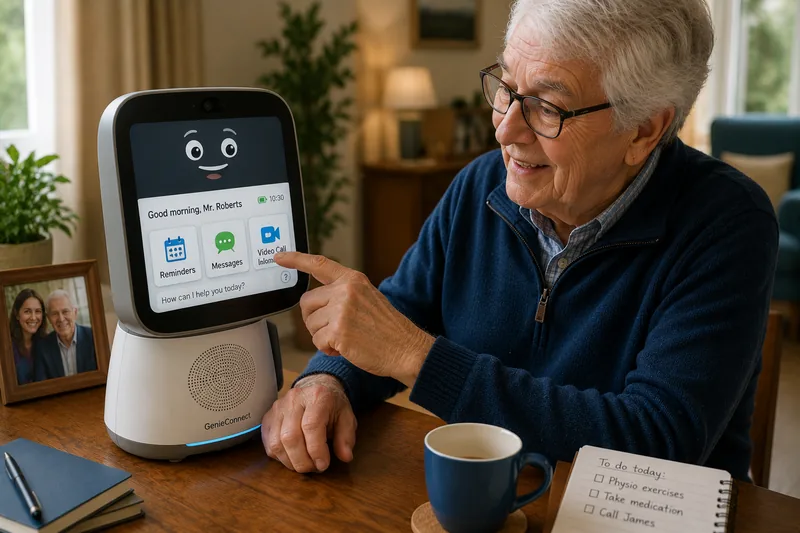
Current UK care technology handles specific jobs well: reminders, video calls, companionship, movement monitoring, personal alarms, medication support and household automation. Families can assemble a useful support network from devices already on sale or available through care providers.
Humanoid robots remain uncommon in ordinary homes, but the underlying pieces are developing quickly. Conversational AI, visual understanding, navigation, robot learning and dexterous hardware are beginning to converge.
What you can obtain now
UK families can buy personal alarms, fall detectors, automatic medication dispensers, smart speakers, robotic pets and camera-free activity sensors. Care organisations can also deploy specialist companion robots and remote-care platforms.
Availability matters. Some products shown in international coverage are sold only in North America or supplied through organisational contracts. The directory labels current access plainly while tracking systems that may become relevant later.
A smart nursing home in Hangzhou reported in August 2026 illustrates another plausible route to robot-supported care: several specialised machines sharing the workload. Emotional-support robots talk with residents, intelligent wheelchairs fetch objects and operate lift buttons, and other robots monitor vital signs and make routine rounds. The report describes a deployment; it does not establish the safety or effectiveness of general-purpose robotic care.
Two new home companions have different routes to market. Tuya has announced Doova for older people living independently, with mobile calls, reminders and smart-home control. AnAn’s maker reports a first production batch and German and Belgian distributors. Neither announcement establishes a supported UK purchase.
October brought a more practical UK arrival: the HMD 2660 Flip Senior Edition puts a conversational AI called Mary into a simple mobile phone. That can make companionship easier to try without owning a home robot. Separately, the phone-network switchover makes checking older landline alarms urgent before January 2027.
- Retail devices: straightforward products focused on one or two tasks.
- Monitored services: technology connected to a staffed response service.
- Provider systems: arranged by councils, housing associations or care organisations.
- Emerging robots: early products and pilots combining conversation, movement and increasingly capable AI.
The humanoids moving toward production
The strongest near-term signal is no longer a single laboratory prototype. Several companies now publish order routes, production targets, overseas support terms or evidence of growing fleets. China has a particularly broad field, ranging from inexpensive development robots to human-presenting service machines such as XPENG IRON and AGIBOT A3.
Most will begin in factories, shops, exhibitions and supervised services. Those deployments matter because they build manufacturing capacity, reliability data and task experience before robots enter less controlled homes.
XPENG announced an operating IRON production line on 8 September 2026. External commercial deliveries remain planned for 2027. Devanthro’s Robody takes a care-specific route: its new EU-funded project combines AI assistance with remote human operation. The handover between them needs validation before families can rely on it.
Figure reported an encouraging advance in September: its Helix 2.5 system carried out three household tasks in 30 previously unseen homes without gathering training data in those houses. In October, Kawasaki unveiled Home LEO, designed from the outset for older people at home, while Chery announced global pre-orders for AiMOGA Mobo. These are manufacturer announcements and tests, but together they show increasingly serious investment in useful domestic work.
- Home-first systems: 1X NEO and Figure 03 are being designed around household tasks.
- Service humanoids: AGIBOT A3 and LimX Luna emphasise interaction and public-facing work.
- Lower-cost platforms: Unitree R1 and G1 make humanoid hardware accessible to more developers.
- Industrial scale: UBTECH, Apptronik, DOBOT and Pudu are building the hardware and training systems that later domestic robots may inherit.
Faces will matter
A domestic robot is furniture, appliance and social presence at the same time. Companies are already moving away from exposed industrial frames toward soft coverings, expressive displays, rounded shells and, in XPENG’s case, a full-body soft skin. The market will test everything from deliberately cute machines to androids with synthetic human faces.
Appearance will be personal. Some people will prefer a clearly mechanical assistant; others will want warmth, eye contact and a recognisable face. Safety, competence and privacy still determine whether the relationship survives beyond the first impressive afternoon.
Follow the machines approaching homes
The Humanoid Care Robot Tracker follows production, ordering, household demonstrations and UK relevance. It separates robots that can be bought or hired from systems that remain internal fleets or development programmes.
As assistants become more capable
The important transition will be from isolated devices to systems that understand context. A future assistant could combine conversation, routines, medication, movement, appointments, family contact and changes in behaviour instead of treating each signal separately.
Robots able to navigate ordinary homes and manipulate everyday objects could fetch items, carry drinks, open doors, support exercise and summon the right kind of help. Each of these abilities exists in partial form; reliable integration is the difficult part.
Rehabilitation evidence is much narrower than the broader care-robot literature. A 2026 scoping review found only 11 empirical studies of embodied robots used specifically for physical or cognitive rehabilitation in older adults, mostly small, preliminary or task-specific studies. That is an important boundary when interpreting broad claims about robots supporting exercise or physical recovery.
A September nursing-home study of Inrobics Rehab adds encouraging usability evidence from ten residents, but no controlled evidence of clinical benefit. Separately, the University of New Hampshire reports dementia-support testing in participants’ homes. These are useful steps with different evidential weight.
What advanced AI could change
There is no dependable date for artificial general intelligence, and forecasts differ widely. Broadly capable AI would nevertheless change care robotics substantially because the machine could reason across unfamiliar situations, explain decisions and learn new tasks with less specialist programming.
Artificial superintelligence would make detailed product forecasts especially unreliable. The reasonable conclusion is broader: increasingly capable intelligence combined with improving robot bodies could make later life far more independent than it is today.
The engineering challenges still worth solving
Physical care remains difficult. Safe lifting, washing, dressing, meal preparation and unpredictable emergencies demand dexterity, judgement and robust safety systems. Homes are cluttered, people move unexpectedly and socks continue to be hostile terrain.
Privacy, consent, cyber security and graceful failure will matter alongside intelligence. A highly capable robot needs clear limits, local controls and a dependable way to involve humans when uncertainty is high.
A sensible way to use the site
- Solve any urgent present-day problem with technology that already works.
- Choose systems that can be upgraded or integrated where practical.
- Track emerging robots without relying on announced release dates.
- Separate demonstrated capability from laboratory potential and marketing imagery.
- Review needs regularly as both the person and the technology change.
- Remain optimistic: care robotics is still near the beginning of its development.
Useful now
Start with products that solve a specific problem today
For present-day decisions, the fall-detection and robotic-pet guides compare products already used in UK homes or care settings. Existing landline alarms also deserve a compatibility check before the January 2027 switchover.
Updated tracker
Follow individual humanoids
Compare production status, order routes, home relevance, appearance, hands and official sources across the robots moving closest to everyday use.
When professional advice matters
Seek appropriate medical, pharmacy, occupational-therapy, social-care or safeguarding advice where the decision affects medication, emergency response, capacity, consent, mobility or significant risk. A website cannot observe the home, the person or the family’s ability to respond.